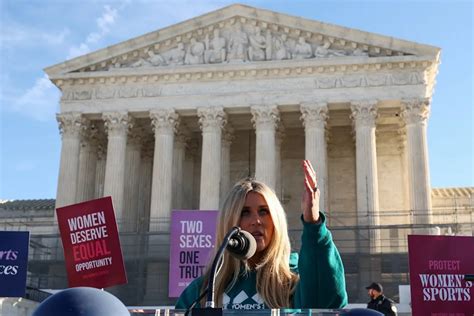
For years, women who highlighted the undeniable truth—biological males hold physical advantages over females in athletic competition—faced smear campaigns, threats, and public shaming. They were labeled as being on the “wrong side of history,” dismissed as bigots or transphobes. Now, after a landmark Supreme Court ruling, these advocates have been vindicated.
This struggle transcended legal briefs. It centered on mothers watching their daughters wonder whether they would ever compete on an equal playing field. Female athletes sacrificed careers and reputations to speak the truth many Americans privately acknowledged but rarely voiced.
Last year, Simone Biles targeted Riley Gaines in now-infamous X posts, criticizing her for speaking out about a transgender pitcher who won a Minnesota girls’ softball championship. Biles mocked Gaines’ physique by saying, “bully someone your own size, which would ironically be a male.” The exchange ignited the largest cultural controversy within the “Save Women’s Sports” movement.
Gaines did not retreat. Instead, she stood firm. After the Supreme Court upheld state laws protecting women’s sports, Gaines described feeling “absolutely vindicated.” Since tying transgender swimmer Lia Thomas at the 2022 NCAA championships, Gaines has been the driving force of this movement—enduring criticism from media elites, activist groups, and Olympic royalty.
Today, Gaines continues to rally elite female athletes. “Let this be a clarion call, not just to Simone, but to every elite female athlete, professional female athlete, the likes of Caitlin Clark and Sophie Cunningham, Serena Williams, to link arms,” she said. The woman who faces national television mockery responds with an invitation—this is not weakness, but backbone with class.
Gaines is no longer alone. MyKayla Skinner, Biles’ former U.S. Olympic gymnastics teammate and a Tokyo Games silver medalist in vault, has firmly joined Gaines’ cause. Skinner’s motivation? A simple desire: “I have a little daughter, and we are hoping to put her in sports soon… I just really want her to have everything that I got to have.”
Skinner directly addressed Biles: “I think it would just be really cool to see Simone stand with us. She’s one of the best athletes in the world.” Skinner knows the cost of crossing Biles—after commenting on the 2024 Olympic team’s “talent and depth,” Biles publicly criticized her, and Skinner received death threats and messages claiming she was “unfit to raise a child.”
When pressed whether Biles meant what she said to Gaines, Skinner replied: “100% yes.” “I’ve known Simone since I was 13… There’s times where she has belittled me as an athlete, as a person, bullied.”
Gaines offered the most telling commentary on the situation: “You could even notice the very obvious tone switch between the initial tweet or two and the very ChatGPT-coded apology.” Despite that, she accepted the apology—proving her character.
The Supreme Court did not resolve all questions about transgender athletes in competition. But it affirmed what Gaines has argued since 2022: states have the authority to protect female athletes from fundamentally unfair competition. Common sense finally won in court.
Gaines looked at her daughter and declared she wants her to inherit “a more fair, more safe, more prosperous, more opportunistic world.” Then, she issued a final challenge: “Let it be known that you also think young girls are worthy of calling themselves champions one day.”
The question is no longer whether Riley Gaines was right. The highest court in the land has answered that. The only question remaining is who has the courage to stand beside her.