You need a photo ID to board a domestic flight, fill a prescription, or buy a six-pack at the gas station. Meanwhile, requiring Americans to verify their identity before casting a vote in a federal election remains one of the hottest fights in Washington. Thirty-six states already request or require some form of voter identification. Polls show massive bipartisan support for the concept. Yet for Democrats, opposing voter ID has become something close to a religious commitment.
The fight escalated this month when President Trump delivered a primetime address urging Congress to pass the SAVE America Act, legislation that would require documentary proof of U.S. citizenship to register for federal elections. Democrats responded with predictable ferocity, branding the bill “voter disenfranchisement” and insisting the current patchwork system works just fine. Then one of their most senior senators walked onto national television and demonstrated a lack of understanding about how voting operates in his own state.
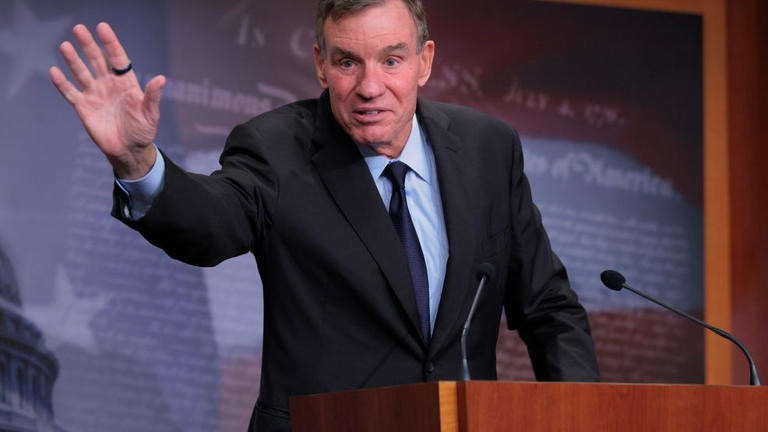
Sen. Mark Warner (D-VA) incorrectly described Virginia’s voter identification law during a Sunday interview, prompting a correction from the host of a television program that aligns with Democratic leanings. The awkward exchange occurred during an interview with host Jonathan Karl on national television, as Warner criticized President Trump’s election security agenda and defended Democratic opposition to the SAVE America Act.
Warner, who serves as the top Democrat on the Senate Intelligence Committee and positions himself as one of his party’s foremost voices on election security, stated: “in Virginia, we have voter ID and photo ID.” Karl, who actually votes in Virginia, countered that this was inaccurate. Under Virginia law, voters can present a range of acceptable documents or simply sign an affidavit to cast a ballot without a photograph.
Warner attempted to recover by stating that Virginia has “voter ID of one form or another.” This response reflects the kind of vague retreat taken when caught wrong and under scrutiny.
Warner’s ignorance about his home state was not even the worst part of his interview. He also referred to the SAVE America Act as “voter disenfranchisement” and claimed it would block women who changed their names after marriage from voting. Additionally, he alleged that Republican states accept “NRA gun licenses” but refuse student IDs.
The claim about student IDs is engineered to generate outrage without factual accuracy. A report by The Daily Wire noted that a majority of states accepting handgun carry permits also accept qualifying student IDs under specific circumstances.
This approach—making emotionally loaded accusations, getting the facts wrong, and hoping no one verifies—is characteristic of Democratic strategy on election policy. Unsurprisingly, the person who verified the facts was the host of a television program aligned with Democrats.
What makes this incident particularly notable is that days before his interview, Warner publicly dismissed concerns about foreign interference in elections and declared American electoral processes to be completely secure.
Warner lectures the president on election integrity while dismissing legitimate concerns about noncitizen voter registration. He opposes common-sense reforms that majorities of Americans support. Yet he cannot accurately describe how citizens vote in Virginia—a state he has represented in the Senate since 2009.
This incident highlights a troubling lack of expertise within the Democratic Party on election security issues. Those who remember when both parties treated election integrity as sacred ground find this kind of ignorance deeply concerning.
Voter ID is not radical; it is normal. The SAVE America Act deserves an honest vote, and those blocking it owe their constituents something Warner clearly cannot deliver: basic competence on the very issues they claim to champion.
Senator Warner should begin by learning how voting operates in his home state before lecturing others on the topic.